The Production Process
As a fan of documentaries, I was very excited to start this unit but I was also nervous as this would be our first ever group project. This meant everyone would need to take on roles within the group and pull their weight. I was worried that I would get left with the boring, tedious roles, however, we all communicated well and ended up dividing up the roles fairly.
Coming up with an idea at first seemed very difficult. We all had different ideas about what to do the documentary on, so I was worried that someone in the group may end up being disappointed if their idea wasn't chosen. We all individually came up with ideas and presented them to each other in our ideas support meetings with Zoe. We quite quickly settled on the idea of doing a documentary revolving around driving and the problems / issues young drivers face. I think the reason we were all interested in doing this documentary was because the topic is very relevant to us as we are all young drivers in the group. As the subject relates to us (as a young group) we were also pretty confident that it would relate to the 'BBC Three' young target audience of the documentary.
Once we had settled on the idea, we then had to decide what to include in our documentary. We decided on trying to get in contact with some experts, people learning to drive and people who had learnt to drive in the past. Although we had many issues finding contributors, we eventually found some people who were happy to be a part of our documentary. We pitched our idea to Zoe and Helen and they both gave us tips and advice on how to improve our idea.
Our final interview subjects were:
- Yvonne and Tony - Alex's grandparents
- Aidan - a learner driver
- Samantha Joslin - an insurance broker
As well as our lectures we also had different workshops including the interview workshop and the location workshop at Chatham Dockyard. These workshops helped us to understand how to film the different parts of our documentary. The interview workshop allowed us to practice interviewing a subject. We had to use questions that would give us self contained answers such as "Can you describe your morning for me?" The dockyard workshop helped us to understand what it is like to film actuality and sequences. My group was based in the rope factory. We were lucky enough to get to film their demonstration of making rope. This gave us some practice of filming actuality and trying to capture everything that was going on. When filming actuality, you have to prioritise which shots you want as everything is occurring naturally. When filming sequences, you can re shoot them again and again if you need to.
The pre production was a lot more work than we anticipated. So again, we split up the roles in order to make the workload a bit lighter. We all helped with the pitch and contacting the people to be in the documentary, Alex wrote the scripts and I filled out the risk assessments. Once we had our script sorted and our equipment booked out, we could then schedule our shoot days and plan out what needed to be filmed and when.
We scheduled our shoots using google docs as this was the easiest thing to do.
1st shoot day: Interviewing Alex's grandparents - Alex, Katie, Jason
2nd shoot day: Filming opening sequence and GVs - Alex, Jason Sonia
3rd shoot day: Filming more pieces to camera and sequences - Alex, Katie
Filming insurance broker - Katie
4th shoot day: Filming the interview with Aidan - Alex
Filming more of the opening sequence - Alex, Sonia, Katie
Filming GVs - Alex, Katie
Overall, our shoot days went okay. My main role was camera operator, I helped to film the interview with Alex's grandparents, GVs, pieces-to-camera, the interview with the insurance broker and some establishing shots. We did encounter several problems which are detailed in the separate blog posts but we found solutions to these and were able to edit around these problems in the post production.
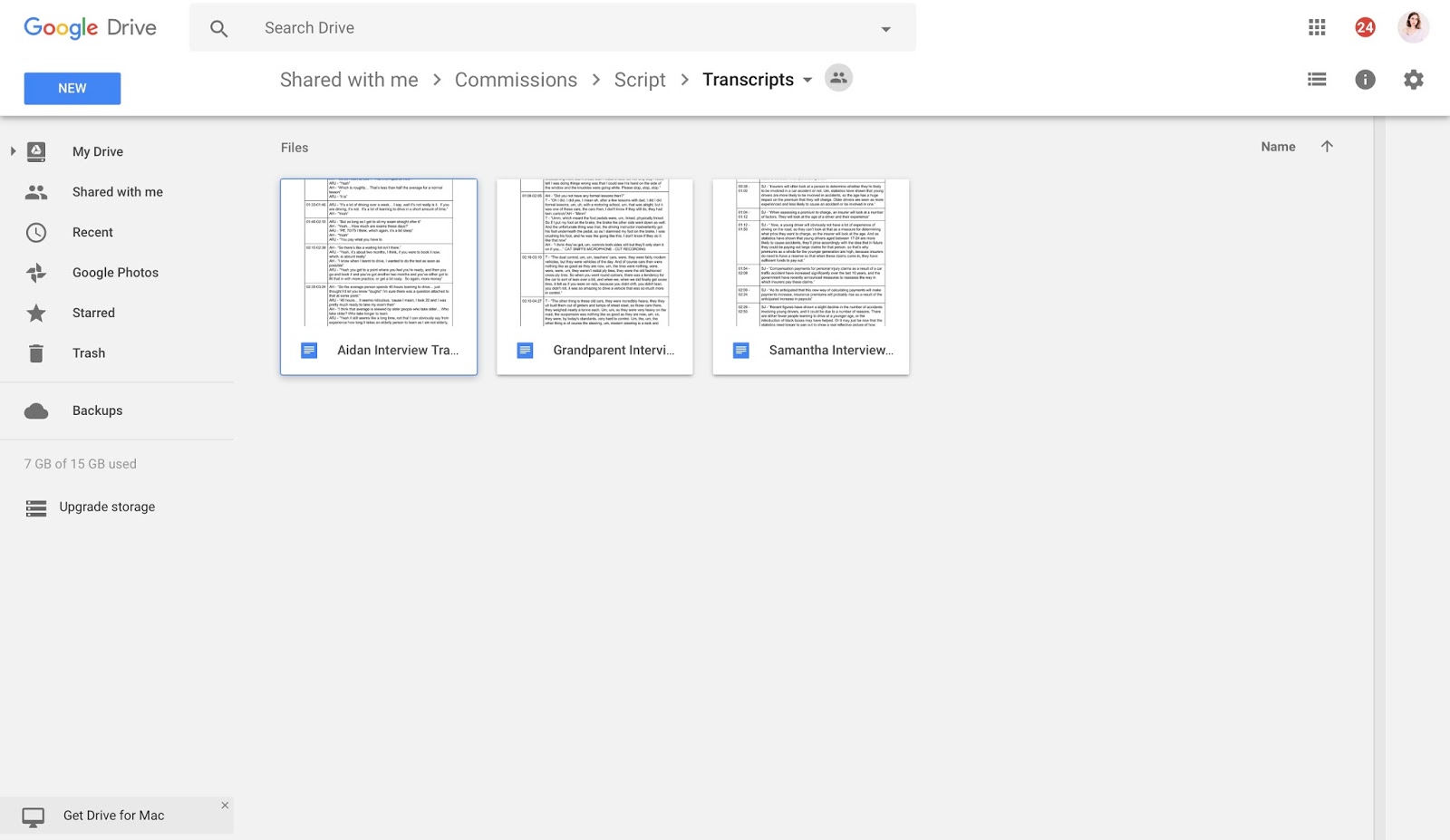
The post production process had more steps than we realised. First of all we had to transcribe and time code the interviews - myself and Alex split this job equally between us. We then had to create a sync assembly of the interviews using the time codes of the bits of footage we wanted to include in our documentary. I did the sync assembly for the insurance broker interview and began the sync assembly for the interview with Alex's grandparents. Further into the edit, I also helped to add in GVs and cutaways over the interview with Aidan. By splitting up the jobs for editing, we were able to get a lot more work done. Alex did the majority of the editing as this is really his strong point but we all did our fair share as well. We did have to re shoot a few bits during the edit due to not having enough GVs or any establishing shots - myself and Alex did this. We also had an issue with the grainy footage of the closing shot. However, with the help of Gavin and the programme 'Neat Video' we managed to reduce the grain. Throughout the editing process, we had feedback from Zoe and Sam. We took their advice on board and implemented it in our edit. The main piece of feedback was to make the documentary less linear, this is clear in our final cut where the interviews merge together.
What worked?
- I really liked the GVs we managed to capture. We decided to film GVs during most of the shoots and on some separate days - giving us a lot to work with in the edit. Filming a lot of GVs allowed us to have footage to cover any jump cuts that were apparent during the interviews. My favourite GV / sequence is the low angle shot I captured of Alex's car driving away.
- I also like the sound in our documentary. Sound has always been an issue before for me in my projects, but the sound in this project was fine (despite filming a lot of footage in cars with the sound of the engine / the road surface). To capture the sound we mainly used clip mics - these were used in Alex's pieces to camera, the interview with Aidan, the interview with his grandparent's (on Alex) and the interview with the insurance broker. We also used a directional mic for the interview with Alex's grandparents and as a back up on some of Alex's pieces to camera.
- I also really liked the locations used in this documentary. The interview with Alex's grandparents was a casual chat so had to take place somewhere cosy and casual - Alex's house was perfect for this. Most shots were shot in Alex's car or Eastgate car park which is relevant to the documentary subject. The interview with the insurance broker was filmed at Eastgate in an office setting with a large window displaying a car park behind the interview subject. All of our locations really suited the documentary and its subject - following conventions of documentaries.
What didn't work?
- We initially planned to have a driving instructor feature in our documentary as well to talk about young drivers on the road. To start off with we did have 2 potential instructors lined up, however, both of them became unavailable. Sonia then found Paul - a driving instructor is Maidstone who appeared to be willing to be in the documentary. However, a week or two before filming, he stopped replying to messages. We were then left with no driving instructor - leaving it down to our insurance broker as the only expert in our documentary. Instead of having a driving instructor, we managed to find a learner driver.
- The opening sequence seemed quite long but this is necessary in order to introduce the subjects within the documentary. We did cut it down significantly due to the feedback from Zoe but it is still longer than the opening sequence of a conventional documentary.
What did I learn?
- I learnt how to work efficiently in a group. We managed to divide up the roles fairly so that everyone played their part. We did have areas where one group member was more 'in charge' than others. For example, I felt like on some of the shoot days I was in charge of the camera operations, on other shoot days Jason was in charge of operating the camera and during the edit Alex was in charge. Even though at points certain people were in charge, we still all worked as a group and did our fair share of the workload.
- I also learnt that the importance of transcribing and time coding. When beginning the sync assembly for the interview with Alex's grandparents, I noticed the time codes didn't match up. This made doing the sync assembly a lot longer compared to when I did the sync assembly for the insurance broker where the time codes did match up.
What could I develop?
- Our scheduling could have been better. There were a couple of shoots where there were only two of us out of the group, or in the case of the interview with the insurance broker, I was the only one available. We just needed to communicate better within the group, although we still got all the footage we needed.
Conclusion:
I am very happy with the overall outcome. A lot of work went into the post production in order to make all the footage fit together. Even once we had finished filming, it didn't feel complete. We didn't feel like we had enough footage, but when it came to editing we realised we had more than enough in some places and just needed to get a few extra shots in others. It is disappointing that we had so many contributors drop out as it would have been really good to get the opinion of a driving instructor. I am really happy with the sequences in the documentary, they really help to set the scene so that the audience is clear on where the documentary is taking place. I am also happy with the sound in the documentary as this has been a problem in my past projects, so it is a relief to have a project which sounds good. Our scheduling / communication with each other wasn't great which made some parts of this project stressful, but I am really happy with the end result and feel that everyone in the group pulled their weight.
Showing posts with label Commissions. Show all posts
Thursday, 18 May 2017
COMMISSIONS UNIT: Final Cut - Bumps In The Road
After weeks of shooting and editing, we finally produced the final cut of our documentary. We took on the feedback given to us in the sessions with Zoe and Sam and implemented it to improve our documentary. Our initial rough cut was very blocky and linear. We changed this by merging the insurance broker interview in with the other interview segments. The rough cut also seemed very dull due to the lack of music, we amended this by adding in music to our final cut. Here's our finished project:
Wednesday, 17 May 2017
COMMISSIONS UNIT: The Edit
After our sync assembly workshop with Sam, we decided to start on the sync assembly for our own documentary.
The first thing we did was write the transcripts for our documentary. Myself and Alex split this job equally between us. I transcribed the interview with the insurance broker whilst Alex transcribed the interview with Aidan. We then both did half of the interview with his grandparents.
Once these interviews were transcribed, we highlighted the parts that we wanted to include in our documentary. We all then took different segments of our documentary and put them into a sync assembly. Splitting the work made it a lot quicker and easier.
When putting the highlighted sections into the sync assembly, we realized that certain bits were too long and other bits didn't fit in with narrative of our documentary. We then amended our transcripts / highlighted transcripts so that they were the same as what we included in our sync assembly. We also then amended our edit script so that this fit with the footage that we ended up including in our assembly.
Once we had the sync assembly sorted, we then began adding in more footage, cutaways and GVs. Alex took control of the editing, however, we all helped out with editing different bits. Sonia and Alex edited the opening sequence together as well as doing the interview with Aidan together. I edited the insurance broker interview together and added cutaways and GVs over the interview with Aidan. Jason then began implementing the feedback we received from Zoe and Sam and attempted to make the edit less linear. He did this by trying to fit in parts of the insurance broker interview with the interview with Aidan. He also added markers to the timeline in order to make it easier for future edits.
Whilst editing, we realized there were a few more bits of footage that we needed. Me and Alex decided to film these extra bits - we filmed some more exterior GVs of his car, the establishing shots for the locations and a few more driving clips. We were then able to merge these clips into our edit - this gave our edit a much clear feel - the audience now know where the interviews are taking place rather than just being thrown into the interviews.
During the edit for our rough cut, Alex filmed his commentary. He did this by following the script, however, he changed the wording slightly in order to make it feel more natural and flow better. Where Alex changed the wording, he updated the script.
We implemented the advice from Zoe and Sam in order to improve our documentary. The main things we had to do was make our documentary less linear in order to flow better and to add titles to clarify who people are.
Although it is only a very small part of the documentary, one of my favourite parts is the title. Alex managed to do this by creating a mask on the car so that the title would be revealed as he drove away.
COMMISSIONS UNIT: Feedback from Zoe on our Fine Cut
Today we received some feedback from Zoe on our fine cut.
- She recommended that we speed up the introduction. It takes too long to get into the documentary and therefore may lose the audience's attention at this early point in the documentary. Alex's delivery is quite slow (which is intended) so we just need to add some fast paced music in order to lift the mood. We have already begun searching for music, we just need to add it into the edit.
- She also recommended that we cut down the interview of Alex's grandparents. We just need to keep the important facts and cut out the parts where there is no new information being revealed. We also need to cover the jump cuts with GVs and other cutaway shots. Zoe also suggested that we could paint Alex's grandparents as 'the enemy' as they may be more dangerous than young people on the road and therefore be unfairly pushing up the price for young people.
- We also need to add in establishing shots in order to introduce the locations and subjects. We have filmed these shots, we just need to add them into the edit.
- We still need to merge the interviews more. We need cut up the insurance broker's interview and use clips of it throughout the documentary rather than leaving the interview as a big chunk at the end of the documentary.
Tuesday, 16 May 2017
COMMISSIONS UNIT: Scripting Our Idea - All stages of production
Alex took control of scripting our idea. Our lecture with Helen on scripting allowed us to see the format of a script.
Following the same format, Alex put our ideas into a script. We had many different versions of the script which developed during the pre production phase of production. We used google docs so that we could all contribute our ideas, however, ultimately it was Alex who created the script.
Once we had begun shooting, we began to highlight our script so that we knew what had and hadn't been filmed. This helped us to work out what needed to be shot on each day.
When editing began, we again adjusted the scripts to match the edit. This is a good idea as if anything happens to the edit and you have to start again, you know what order the footage needs to be in. Time codes are also used in this version of the script - which again makes it easier if any edits are lost. Here's a sample from our final edit script:
COMMISSIONS UNIT: Feedback from Sam about our rough cut
Today Sam viewed our rough cut and gave us some feedback and pointers.
- Overall, the content of our documentary is pretty good. We have all the footage we need, we just need to play around with it and perhaps change the order of it to make it more interesting for the audience.
- Sam agreed with Zoe's advice we received on Friday, the structure of our documentary is still too linear at the moment. We still plan on moving around our footage in order to make it less linear. For example, during the interview with the learner driver, he talks about taking an intensive driving course and how he thinks these are a good idea. We will then include the footage of the insurance broker where she disagrees with these courses as she believes they are unsafe and don't teach people how to actually drive, just how to pass a test.
- The audio is still a bit messy. Some clips are loud whereas others a quiet. We still need to play around with this and make all the footage the same volume.
- It would also be a good idea to get more GVs whilst driving (i.e. by putting a GoPro on the windowscreen and driving around a bit). This will give more footage to use during Alex's interview with the learner driver).
This feedback has been very helpful as it has given us a clearer idea of the steps we need to take in order to improve our documentary. We will take this advice on board and implement it before our fine cut viewing.
Friday, 12 May 2017
COMMISSIONS UNIT: Feedback from Zoe about sync assembly / rough cut
Today we got some feedback from Zoe about our sync assembly / rough cut. Overall the feedback was pretty positive, however, she gave us some pointers in order to make our documentary flow better.
- Our documentary seemed a bit linear, all the footage is in chunks. It would work better if we spread the segments out a little (e.g. using some of the insurance interview footage between clips of the interview with the learner driver). It would work better if we had 3 topics and using the different interviews to explore these topics rather than just having all the interviews separate.
- The documentary could do with having another authority figure such as a policeman or a driving instructor. We agreed with this piece of advice as it would add a lot of weight to our arguments, however, we are unsure whether we will be able to capture this footage in the limited time we have left.
- The interview with Alex's grandparents seemed too long and therefore the audience would lose interest. We will cut down the interview in order to make it shorter and more to the point. We also need to add in the cutaway clips and GVs over this interview in order to cover the jump cuts.
- It may also be better if Alex wasn't in every shot. It is very rare to see the presenter in every shot in a documentary - therefore, our documentary would follow the codes and conventions of the genre better if Alex wasn't in every shot. It will also make it more interesting for the audience.
Monday, 8 May 2017
COMMISSIONS UNIT: Sync Assembly Workshop
We had a sync assembly workshop with Sam. He told us what exactly a sync assembly is and how to go about putting footage into a sync assembly. He gave us an edit script to follow with the time codes of the interview - we then had to find these time codes and include these in our edit. Once we had our sequence ready, we could then add some GVs and other cutaways. However, our main focus was to just getting the basic sequence down. I managed to get the basic sequence done and left gaps for the commentary.
Here's my piece:
Here's my piece:
Friday, 5 May 2017
COMMISSIONS UNIT: (Production) GVs
As well as shooting some GVs on our shoot days, myself, Sonia, Alex and Jason also filmed GVs with our own equipment whenever we had the opportunity to give us the maximum amount of footage.
Myself, Sonia and Alex all own our own GoPros so we each set these up to record in our cars on different journeys we made, allowing us to capture a lot of footage on the road. This also gave us a lot of variety of footage due to the different locations in which we all live. Sonia and Alex mainly captured town and busy roads whereas I was able to capture some country roads. Here's the GoPro footage I captured:
Jason filmed GVs from Alex's car, the camera was attached to the tripod which was secured to the car seat whilst he operated the camera. Jason also filmed clips of the outside of Alex's car. These GVs will be distributed throughout the documentary.
Whilst doing the location recce at Eastgate Events Venue for the interview with the insurance broker, I noticed a good shot of the A2. I set up my camera and tripod and filmed the A2 for around half an hour. This meant we could use this footage either as it was or sped up to act as a time lapse.
Other GVs were captured on the shoot days when we were shooting on location (e.g clips of the inside of Alex's car, gear changes, steering wheel etc.) Many of the GVs were filmed on the fourth shoot day.
Once we begun the edit we realized that there were more shots we needed. Myself and Alex made it our job to capture these shots. We captured the extra footage of Alex's car which we needed (the indicator flashing, the brake lights, more GoPro footage and the establishing shots of Alex's house and Eastgate Events Venue).
Thursday, 4 May 2017
COMMISSIONS UNIT: (Production) Shoot Day 4
The fourth day of our shoot was 4th May. The majority of this day was used to film Alex's interview with Aidan - a learner driver. This shoot required just having Alex and Aidan in his car for the interview. Alex rigged up his car with the GoPros and also attached the clip mics to himself and Aidan. The equipment was fully set up before Alex set off so that his concentration could be fully on the road.
Between us in our group we had 3 GoPros - however, we only ended up using 2 of them. These enabled for different angled shots during the interview with Aidan.
Alex did encounter an issue with the sound during the first take of this interview. Since both himself and Aidan had time, they decided to re film the interview.
Once the interview with Aidan was complete, myself and Sonia met up with Alex in order to film some more GVs and sequences.
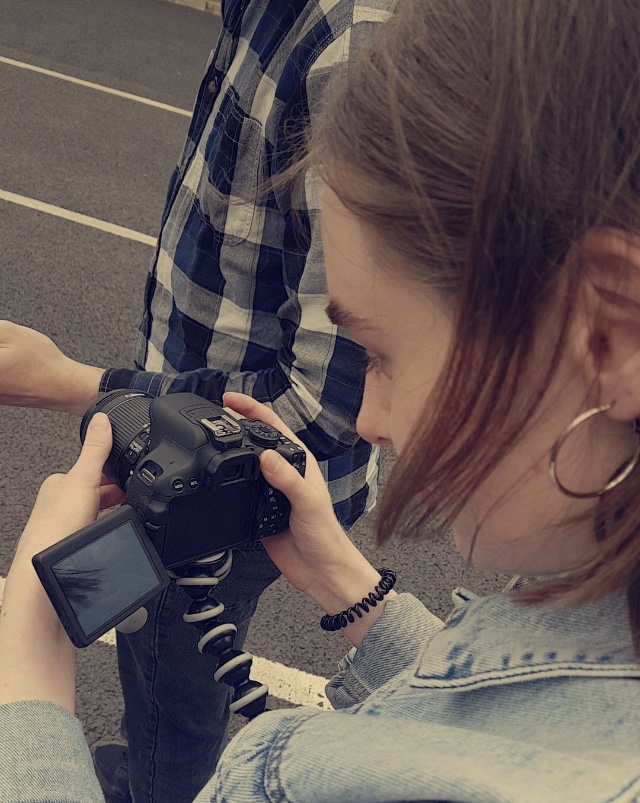
Sonia directed the shoot / acted as a runner before she had to leave and I was the camera operator. In order to capture the GVs and sequences we used a DSLR and a tripod. The footage we needed to capture was mainly of Alex driving about in his car. We also filmed some footage of Alex with his pass certificate and also of him with the keys to his car to be used in the opening sequence. Commentary will later be added to this footage.
We also decided to capture some footage of Alex driving behind my car - in order to do this I attached a GoPro to my back window and drove with Alex following me. We are still undecided about this footage but it is still handy to have available if we want it.
Wednesday, 3 May 2017
COMMISSIONS UNIT: (Production) Shoot Day 3
The third day of our shoot was on the 3rd May. This again took place at Alex's house.
The crew for this shoot consisted of myself and Alex (although Alex had to be on screen for the majority of the shoot). Alex was also able to capture some footage by himself.
The equipment we used for this shoot was the Sony EX camera, a clip mic and the directional mic. We decided to use both types of microphone to have both options when it came to post production (incase there was an issue with the audio from one of the microphones).
This shoot consisted of filming more sequences that would be placed throughout the documentary in order to introduce the segments. For example: we filmed the sequence with Alex looking at his laptop and discussing the cost of learning to drive etc. - this would then lead into Alex interviewing Aidan (a learner driver).
Later on in the day I also had the job of interviewing the insurance broker. I got to the location (Eastgate Events Venue) and set up the equipment. The equipment used on this shoot was a DSLR, a clip mic and two soft box lights.
I was the only crew member on this shoot so I acted as the camera operator as well as interviewer. This worked fine as I didn't need to be on screen as the interviewer, allowing me to stay behind the camera.
The shoot went very smoothly - it took around an hour in total. I managed to capture around 15 minutes of good, usable footage about the insurance prices for young drivers, why the premiums are what they are and what we can expect to happen in the future. This can then be chopped around in post production.
Tuesday, 2 May 2017
COMMISSIONS UNIT: (Production) Shoot Day 2
Our second day of shooting was on the 2nd May.
The crew for this shoot consisted of Sonia and Jason (with Alex presenting the scenes). Jason was the camera operator for this shoot whilst Sonia directed.
The equipment used on this shoot was the Sony EX camera and the clip mic for Alex's dialogue.
This shoot consisted of shooting the opening sequence of Alex introducing the documentary and some GVs of him and his car.
Jason and Alex also shot some footage within the car with Jason on the back seat filming Alex in the front - the camera was secured to the seat when the car was moving. This complies with the University's health and safety guidelines for filming in cars.
This meant once the day of shooting was done, there were only a few shots left to film of the opening sequence and only a few more GVs to film. The script was followed in order to make sure all the necessary footage was filmed, once a piece of footage was filmed - it was highlighted in yellow on the script.
Monday, 1 May 2017
COMMISSIONS UNIT: (Production) Shoot Day 1
We started our shoot on the 1st May. This day consisted of Alex casually interviewing his grandparents about learning to drive when they were younger and generally how driving has changed over the years.
Initially we had decided on interviewing Alex's dad, however, his dad was unavailable and we thought that there would be a greater difference in driving between the time Alex's grandparents were learning and today - making it more interesting and suitable for the documentary.
The crew for this shoot consisted of myself and Jason (with Alex helping to set up but then presenting the scenes on the shoot).
For the shoot we used the Sony EX Camera, a DSLR (Canon 700D), clip mic on Alex, directional mic for his grandparents and Interfit soft box lighting.
I set up the lighting whist Alex dressed the set and positioned the seating. Jason set up the master shot on the Sony EX camera whilst I set up the DLSR to be used for close up shots and GVs.
We were ready to begin shooting at around 5pm. We recorded about 30 minutes of footage that could then be cut down and chopped about. The footage consisted of one consistent master shot (captured on the Sony EX) and many medium and close up shots (captured on the DSLR).
We did notice that there was some grain on the DSLR footage but this could not be helped due to the low levels of light (and the artificial lighting being used). We also experienced another issue which was easily resolved. Half way through a sentence, Alex's cat decided to walk over and sniff the microphone - we decided to briefly stop the interview and then repeat the sentence that was interrupted.
Thursday, 27 April 2017
COMMISSIONS UNIT: Testing Ideas
As none of us had filmed one of our projects in a car before, we decided to test out our filming method. We decided on using GoPros to capture the footage within the cars as this seems to be the safest way of doing so. In order to do this we will mount the GoPros on the window screen of the car in a position where they are not blocking the view of the driver.
Myself and Alex attached GoPros to our vehicles to see how it would work. Alex attached his to his side window whilst I attached mine to my windscreen.
Tuesday, 25 April 2017
COMMISSIONS UNIT: (Pre Production) Scheduling Our Shoot
In order to schedule our shoot week, we used google docs - a place we could all access and see when we were needed for shoots.
Shoot day 1 - Alex will be presenting the scenes, I will be operating a DSLR and Jason will be operating the Sony EX. We will be filming Alex's grandparents and Alex's house.
Shoot day 2 - Alex will be presenting, Sonia will be directing and Jason will be operating the Sony EX. They will be filming the opening sequence and GVs.
Shoot day 3 - Alex will be presenting and filming, I will be operating the camera. I also interviewed and operated the camera for the interview with the insurance broker. We will be filming more sequences, pieces to camera and GVS.
Shoot day 4 - Alex will be presenting / directing, I will be operating the camera and Sonia will be the runner. Alex will film the interview with Aidan and I will film the GVs and sequences.
Monday, 24 April 2017
COMMISSIONS UNIT: (Pre Production) Risk Assessments
I did the risk assessments for the group (with the exception of Alex's house which he did the risk assessment for). In order to do the risk assessments we had to decide on the locations to be used for the shoots and recce the locations.
The main location for the shoot would be Alex's car - he will be presenting segments whilst driving and also interviewing his friend who is learning to drive. Before completing the risk assessment for this location we had to read the health and safety checklist for filming in vehicles. Once this had been read, I could do the risk assessment for Alex's car.
I had to amend the risk assessment slightly, insuring that no handheld footage would be shot while the vehicle was moving. The tripod would be secured in place in the car at all times when filming.
I did a location recce of Eastgate Events Venue - where the interview with the insurance broker would take place. This enabled me to see if there would be any trip hazards or any other hazard that could damage any equipment or injure any people. I also explored the location to see where exactly would work best for the interview. I concluded that the room in front of the car park would be best. This room has big windows that can see out into the car park (and as our documentary is centred around driving, I thought this would be a very good idea).
The room would be emptied before use so there would be no trip hazards. The location also didn't block any fire escapes. We also knew we wanted to get some GVs of Alex driving around, we thought that the grounds of Eastgate Events Venue would also be suitable for this. This would mean there would be some extra hazards (i.e. moving cars, uneven ground, kerbs, loose pavement) but we would plan out any movement with the camera before filming to ensure none of these hazards would be a problem.
The risk assessments were signed by myself and Helen and handed in to Ferg. We now have all the necessary equipment to film our documentary. We will be shooting from the 1st May until the 5th May.
Saturday, 22 April 2017
COMMISSIONS UNIT: (Pre Production) Problems With Contributors
Unfortunately, we encountered a lot of problems in securing interview subjects for our documentary.
We initially had 2 potential driving instructors that were available for the documentary, however, both became unavailable. Sonia then began contacting driving instructors in the local area and managed to find Paul - a driving instructor from Maidstone. This seemed to be secure - although, a week before the shoot, Paul stopped responding to Sonia's messages. We then tried to find another driving instructor but had no luck. We decided to settle with using the insurance broker as the only expert in the documentary.
As we couldn't find another instructor but still wanted to talk about learner drivers, Alex got in contact with his friend Aidan - a learner driver. Although this wouldn't be as good as talking to an instructor / expert - it would still give us an insight into what it is like to learn to drive from the perspective of someone taking the lessons.
Alex's dad also became unavailable, however, his grandparents were more than happy to step in and talk about their driving experiences instead. This actually may end up being a better plan as there will be even more differences between when they were learning to drive and what it's like to learn to drive today.
The insurance broker is still on board for participating in the documentary.
Alex is also still willing to be the presenter.
Thursday, 20 April 2017
COMMISSIONS UNIT: Research - Louis Theroux
As a massive fan of his documentaries, I could not pass up the opportunity to do some research into Louis Theroux and his documentaries. I also thought it would be relevant to our documentary to do some research into Louis Theroux as his documentaries follow him exploring different subjects as the presenter. We also plan on making a presenter based documentary so researching Louis is perfect as it may help us to better understand how to present a documentary as well as how to film it.
Louis shows very little emotion on camera as "The viewers need to be a judge of what they find emotional. [He] really do[es] try not to emote. [He] do[esn't] like seeing it on documentaries - it seems a bit unprofessional." This allows the audience to form their own opinions and judgments on the subject matter of the documentary - it seems that Louis just presents the facts and the situations and allows the audience to judge the situation themselves.
Louis Theroux has many documentary series:
- Louis Theroux's Weird Weekends (3 series)
- When Louis Met... (2 series)
- 28 BBC2 specials
- LA Stories
- My Scientology Movie
Louis has quite a unique presenting style. He doesn't seem to go into the interviews with any sort of obvious bias although he has his own opinion on the matter - he allows the interview subjects to speak their mind and then explores the thoughts they present. Although he may disagree with what the interviewees are saying, he allows them to express their opinion. For example, in his documentary 'The Most Hated Family In America' - he begins by explaining the subject of the documentary whilst displaying actuality footage of the family protesting with their placards. Whilst this does set up the family as 'the most hated family in America', throughout the documentary Louis attempts to understand their beliefs and why the behave in the way they do. He does this by asking the simplest questions which almost trick the subjects into giving him the information he wants. Theroux almost goes into the situation with a false display of naivety. He asks simple questions such as "What do you mean?" which makes him out to be a very naive person - when in actual fact he is trying to extract more information from the subjects.
Louis Theroux's documentaries have a very casual style. The interview subjects always seem relaxed around Louis. Louis has admitted to spending a lot of time with the interview subjects of his documentaries prior to filming and during the production. This helps him to establish a bond between himself and the subjects and enables him to gain information that they otherwise may not share.
Although Louis is the presenter of his documentaries, he is not in every single shot. Some shots will just focus on the interview subjects, others will establish the location. There is a lot of actuality footage in his documentaries. For example, in 'Louis and The Brothel' there is actuality footage of the brothel's newly opened saloon. Actuality footage seems to be more present than sequences - this also helped to give Louis's documentaries this natural, causal and simple feel as most of what we see is naturally occurring.
Much of the footage included in Louis Theroux's documentaries is handheld. This contributes to the natural / casual vibe of his documentaries. It also helps to place the audience in the documentary. As Louis tries to avoid putting too much emotion into the documentaries himself, he immerses the audience in the documentary which allows them to experience any emotions first hand.
How This Has Influenced Our Documentary
- As our documentary also has a presenter (Alex) - we needed to research how prevalent he needed to be throughout the documentary. Louis was in a great deal of the shots but not every single shot. We need to make sure that our presenter doesn't overpower the documentary - he needs to be present but not in every shot. Some shots will need to just focus on the interview subjects to give more weight to what they're saying. It would also be good for Alex to have some kind of relationship with the interview subjects in order to give a much more natural, conversational feel. Alex may also need to include some simple questions in his interviews as well as the more complex questions that will provide us with what we need to know. These extra simple questions will give us extra bits of footage that we may not uncover otherwise.
- It may be a good idea to not force an opinion on the audience. Although we believe that prices for young drivers are too high when compared to the statistics, we should present the facts and allow the audience to decide for themselves. We should still make our message clear but ultimately allow the audience themselves to decide how they feel about young drivers and the financial issues they face.
- Handheld shots are a great way of getting a lot of footage and adding to the natural feel of a documentary. During interviews, we should try and get some handheld shots of the interview subjects as well as a steady master shot. This will allow for a more natural looking, casual documentary.
Sunday, 2 April 2017
COMMISSIONS UNIT: Research - The F Word And Me - BBC Three Documentary
I decided to research another BBC Three documentary to give us a clear idea of the format our documentary should follows. I decided to research The F Word by Charlie XCX.
This is another documentary with a presenter - the same format we wish to follow.
Upbeat, fun music is instantly used from the beginning of the documentary. Even though the subject matter this documentary (feminism) isn't an upbeat and fun subject, the fun music helps people to engage with the subject matter and lighten it a bit.
Charlie begins by explaining how feminism is an issue in the music industry whilst a montage of music videos plays. She then introduces herself - her name, her age and what she does. This is important so that we can relate to her and connect to her and therefore engage with the subject matter.
Charlie XCX is a pop singer and therefore will attract fans of her music to watch the video. Unfortunately, we cannot get a celebrity to present our documentary, but it shows the importance of having a likeable and relatable character as the presenter.
The titles used throughout the documentary are fun - helping the audience to enjoy the documentary as well as learning about feminism. The titles also suit the character of the presenter and her style of music - the font and colours used in the titles are similar to those found in her music videos.
The documentary includes a lot of interviews throughout. These break up her commentary and the facts she's presenting. She talks to other females in the music industry to gain their opinion on feminism.
There is a lot of actuality footage of her performing and sequences of her walking between locations. These help to set the scene of the documentary.
How Has This Influenced Our Documentary?
- This documentary has again shown the importance of having a likeable and relatable presenter. This helps the audience to engage with the subject matter, no matter how dull it may seem to some people.
- Having upbeat music at the beginning of a documentary targeted towards young people is key. It immediately lifts the mood of the documentary and instantly suggests a fun and interesting viewing.
- Sequencing has been shown to be very important. It can help to connect locations and tell the story. It helps to transition from one subject to another within the documentary.
- Lots of interviews make the documentary interesting - especially when they're merged throughout the documentary. This helps to make the documentary flow and make sure it's not too linear.
Wednesday, 29 March 2017
COMMISSIONS UNIT: Location Workshop
Today we had a location workshop at the dockyard in Chatham. We divided ourselves into our documentary group, however, since Sonia was absent, myself, Alex and Jason were joined by Connor. Each group was given a different area of the dockyard to do their actuality / sequence on. We were given the rope factory.
Before we could film, we had to perform a risk assessment of our location - just as we would have to on our actual shoots. The main hazards that we found were trip hazards on the steps and the wooden floor. There were also some beams that we would have to be careful of. There were barriers separating the walkway from the ropes, this was also noted down as a hazard. We agreed that to avoid these hazards, we would block out any filming beforehand. Once we had filled out our risk assessment, we handed it in to Helen and Ferg and picked up the equipment.
We were then instructed to film sequences and actuality of our location and attempt to tell a story without any interviews - just through the shots.
We all took turns in operating the camera - initially this was tricky as we all had different ideas of shots we wanted to get, but it all worked out and we managed to take turns to capture footage. We filmed a lot of close up and wide shots (filming 3 close for every 1 wide). We filmed signs and ropes in order to establish the location and then focused in on equipment and more rope in order to establish what was occurring.
We were lucky enough to have a rope making demonstration occur - this gave us some great actuality footage! However, everything was so fast paced that it was hard to keep up with the action. We had to prioritise which shots to capture in order to get the best footage.
We then reviewed the footage we captured in our location workshop. Overall the feedback was pretty positive, we captured some good footage for our first time capturing sequences and actuality on location. We had some interesting pull focus shots and we also kept to the rule of shooting 3 close up shots for every 1 wide shot. One criticism was that we had too many panning shots that were also too long. Panning shots need to go from point A to point B quite quickly. Our pans were very slow and didn't really reach a point. Panning shots should be used to reveal things - ours didn't do this. Our establishing shots were good - people instantly got a feel for where we were shooting.
After reviewing the footage, we then had to edit it together. Jason and Alex did the edit for this. This helped us to get a feel for editing sequences and actuality which will be beneficial to us when it comes to editing together our documentary project.
Subscribe to:
Posts (Atom)